Guide 4 of 4 · By origin
Best Quality Saffron by Origin
Origin shapes what saffron is likely to be like, but it guarantees nothing. This page compares the main growing regions on typical quality, availability and practicality for buyers in the US.
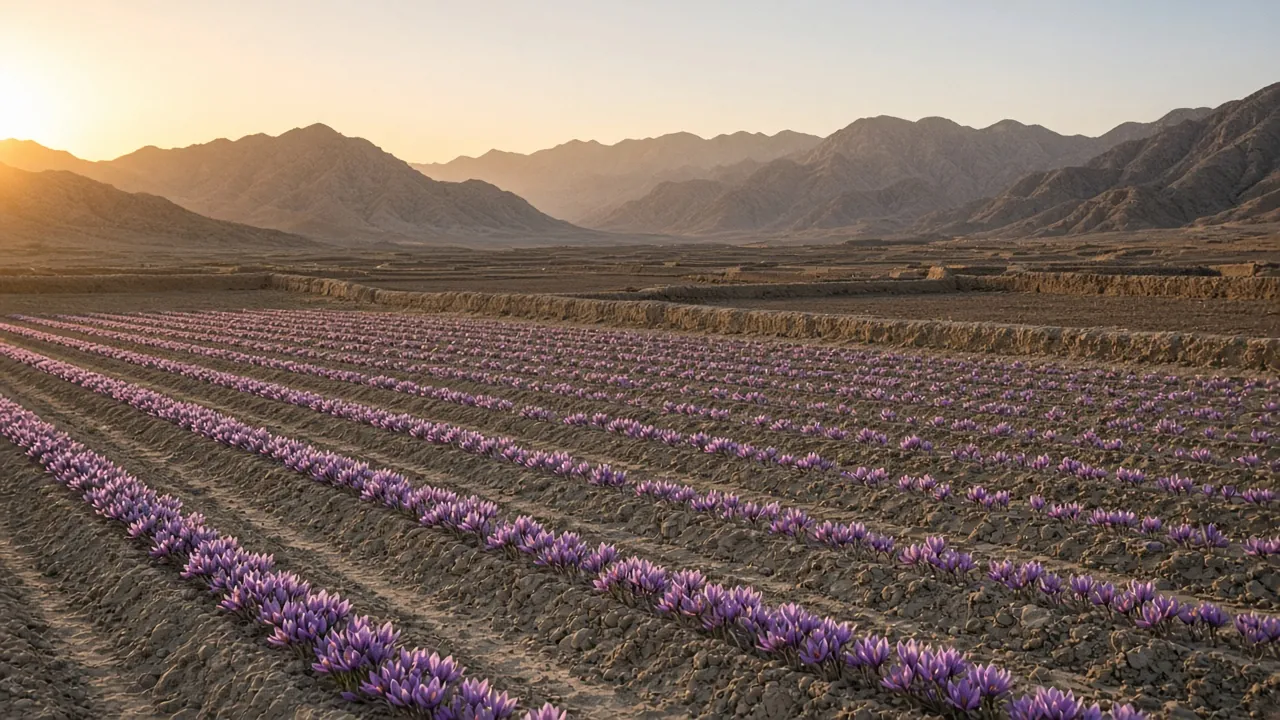
Every origin below grows the same plant. The saffron crocus is a sterile clone spread by hand from corm to corm, so differences between countries come from climate, picking, drying, sorting, storage and labelling rather than from different varieties. That is why the checks in what makes saffron high quality apply everywhere.
Afghan (Herat) Saffron
Why Herat is the main growing region
Saffron is grown in 26 of Afghanistan’s 34 provinces, but one dominates: Herat, on the border with Iran, grew 22,240 kg in 2023, or 95.6% of the national crop. In 2024 Afghanistan was the world’s second-largest producer after Iran.
Typical quality and flavor profile
Herat saffron reaching the US is mostly sold as all-red cuts, Negin and Super Negin. Because the crocus is the same clone, expect the familiar honey-and-hay aroma; how strong it is depends on the lot and its age rather than the flag. Ask for the harvest year and a lab report, as you would for any origin.
Availability for US buyers
Good. Afghan saffron is not covered by the US import ban on Iranian goods, and several US-based sellers stock Herat threads; the board on saffronprice.com lists three, with whole-thread prices from $5.26 to $29.98 per gram depending on jar size (read 20–25 Nov 2026).
How Afghan saffron compares to Iranian
Same plant, neighbouring growing areas, very different scale: Iran grows roughly nine-tenths of the world’s saffron, Afghanistan a small fraction. For a US buyer the decisive difference is legal: Afghan saffron can be imported and sold openly, while Iranian-origin food generally cannot.
Iranian Saffron
Why Iran produces most of the world’s saffron
Iran accounts for around 90% of global production, grown mainly in its semi-arid northeast. The crop is thought to have originated in that wider region, and Iran’s long-established trade gave the world most of its grade vocabulary: Sargol, Negin, Pushal and Konge.
Quality range from excellent to poor
Scale means range. Iran exports everything from carefully sorted all-red lots that would meet Category I to style-heavy bunches and Konge. “Iranian” on its own tells you about as much as “French” does on a bottle of wine.
Top Iranian grades (Super Negin)
Super Negin, Negin and Sargol are the all-red Iranian cuts, and Pushal keeps a little style. What separates them, and why Super Negin is about appearance more than strength, is in saffron grades explained.
Practical considerations for US buyers
Since the general license for Iranian-origin foodstuffs wound down on 6 August 2018, importing Iranian-origin food into the US has generally been prohibited under the Iranian Transactions and Sanctions Regulations. Iranian saffron can still reach shelves under another country’s name, through repacking abroad, which is one more reason to look for a stated growing country. This is a summary, not legal advice.
Kashmiri Saffron
What makes Kashmiri saffron distinct
Kashmiri threads are known for a very dark maroon-purple colour, among the darkest of any origin. “Kashmir Saffron” is a registered Geographical Indication in India (application 635, certificate dated 1 May 2020), with the Pampore area its best-known growing ground.
Mongra grade explained
Kashmir uses two main grades. Mongra is stigma only, Kashmir’s equivalent of Sargol or Coupé. Lachha keeps part of the style attached, like Pushal.
Price and authenticity concerns
Repeated droughts, blights and poor harvests have kept Kashmiri saffron scarce and expensive outside India. Scarcity invites substitution: cheaper Iranian saffron has been mixed with Kashmiri and sold as pure Kashmiri. We have not priced Kashmiri saffron in the US, so we give no figure.
When Kashmiri is worth the premium
When you want Kashmiri saffron specifically, for a regional dish or as a gift, and the seller can show the GI mark and a Kashmir-based producer. If you only want strong, fresh saffron, a verified all-red lot from any origin does the same job in the pot.
Spanish Saffron
La Mancha PDO overview
“Azafrán de La Mancha” has been an EU Protected Designation of Origin since March 2001. It covers saffron grown in the Mancha districts of Toledo, Cuenca, Ciudad Real and Albacete. Its specification requires the stigmas to be dried by toasting and sets lab minimums of more than 200 for colouring strength and more than 70 for bitterness, with moisture under 11%.
Flavor differences vs other origins
The toasting step is written into the PDO rules, so genuine La Mancha saffron is always dried over heat. Separately, Spanish trade varieties sold under names such as “Spanish Superior” and “Creme” are generally described as milder in colour, flavour and aroma. Those trade varieties and PDO La Mancha are not the same thing.
Availability and typical quality
Spain packs and exports far more saffron than it grows. World Bank trade data show about 288,000 kg exported in 2019, while a 2020 Oxford Symposium paper cites a Spanish harvest of roughly 1,500 kg in 2010. Most “Spanish saffron” on shelves was grown elsewhere. Genuine PDO saffron carries the designation on the pack, and its colour and bitterness minimums sit at the ISO Category I level.
Comparison Table
| Origin | Typical Quality | US Availability | Price Level | Flavor Notes | Practical Recommendation |
|---|---|---|---|---|---|
| Afghan (Herat) | Mostly all-red cuts; varies by lot | Widely available from US-based sellers | $5.26–$29.98/g, by jar size | Same crocus as Iran; honey-and-hay aroma, strength depends on lot and age | Most practical for US buyers now |
| Iranian | Widest range, from top all-red lots to style-heavy grades | Iranian-origin food imports generally prohibited | Not priced by us | The reference for most grade names | Not a practical legal option in the US |
| Kashmiri | GI-protected; Mongra is all-red | Scarce; authenticity hard to verify | Premium; not priced by us | Very dark maroon threads | For a specific dish or gift, with the GI mark |
| Spanish (La Mancha PDO) | PDO lots must test above 200 for colour | Available; check for the PDO seal | Not priced by us | Toasted during drying (PDO rule) | Buy PDO-sealed packs only; “packed in Spain” is not the same |
Which Origin Is Most Practical for US Buyers Right Now?
Current availability considerations
Iranian-origin saffron is effectively off the table for US buyers. Kashmiri saffron is scarce and hard to verify. Genuine La Mancha PDO is grown in small volumes. Afghan saffron is the origin you can most easily buy from a US-based seller, with a stated growing region.
Quality-to-access balance
Since every origin can produce top lots, the deciding factors are traceability and freshness, not prestige. A Herat tin with a harvest year and a lot number is a better buy than a famous name with neither.
Recommended approach for most buyers
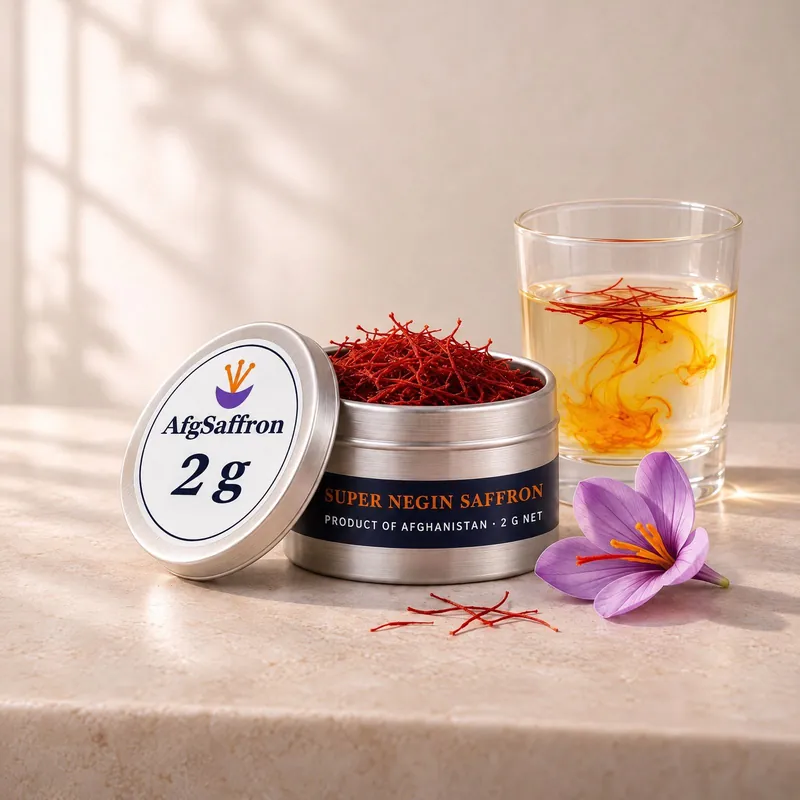
Choose all-red Herat saffron (Sargol, Negin or Super Negin) from a US-based seller that prints the harvest year and lot number and will share a lab report. Buy a size you can finish in about a year.
Affiliate links: we earn a commission if you buy through this or any AfgSaffron link on this page, at no extra cost to you.
How to Choose Based on Your Needs
Best origin for cooking
Afghan or PDO Spanish, in an all-red cut. Both are traceable in the US, and once threads are steeped into a dish, freshness matters far more than the country.
Best origin for gifting
Long Herat Super Negin in a tin, a PDO-sealed La Mancha pack, or GI-marked Kashmiri if you can verify it. A label that names the harvest year makes any of them a better gift.
Best origin for value
Afghan saffron, in the largest size you will finish while it still smells strong. The lowest per-gram price we saw was $5.26, for a 1 oz tin listed on 26 Nov 2026. Right now the in-stock size is the 2 g jar of Herat threads (listed at $19, or $9.50 a gram, that day).
Related Questions
Which country has the best saffron?
No country has a monopoly on quality. Iran, Afghanistan, Kashmir and La Mancha all produce top lots, and La Mancha’s PDO writes Category I-level minimums into its rules. For US buyers, Afghan saffron is the most practical traceable choice right now.
Is Afghan saffron as good as Iranian?
It is the same crocus grown in neighbouring regions, so a well-handled Afghan lot can match a well-handled Iranian one. Judge the lot: cut, harvest year and lab report.
Is Kashmiri saffron better than Iranian?
Kashmiri saffron is darker and rarer and has GI protection, but rarity is not strength. Both origins range from excellent to poor, and mislabelled blends exist.
Does origin matter more than grade?
Usually not. Grade (how much style is left) and freshness change what a pinch does more than the country does. Origin matters most for traceability and, in the US, for what is legal to buy.
Sources
- Nazarian, Nassiri Mahallati & Khorramdel (2025), Journal of Saffron Research 14(1): Herat grew 22,240 kg, 95.6% of Afghanistan’s saffron, in 2023
- Wikipedia, Saffron: grades and ISO 3632 categories, adulteration, world production (read 27 Nov 2026)
- 31 CFR 560.534 (eCFR): the general license for Iranian-origin foodstuffs wound down on 6 August 2018
- Intellectual Property India, GI application 635: Kashmir Saffron (certificate dated 1 May 2020)
- EU Official Journal C/2025/5116: Azafrán de la Mancha PDO single document (toasted stigmas; colouring > 200, bitterness > 70)
- WIPO appellation AO-1225, Azafrán de La Mancha: EU registration under Regulation (EC) 464/2001, March 2001
- World Bank WITS: Spain saffron (HS 091020) exports, 2019
- Shepro (2020), The Geopolitics of Saffron and the Puzzles of Saffron Arithmetic, Oxford Symposium on Food & Cookery
- Kentucky State University Cooperative Extension, Saffron Types and Quality Indicators (fact sheet, 2020–2021)
Last reviewed 27 Nov 2026. Prices are dated where they appear; lab limits are quoted from the standard edition named beside them.