Guide 1 of 4 · Quality markers
What Makes Saffron High Quality?
Saffron quality comes down to a few things that can be measured or checked, not to the words on the front of the jar. This guide covers the indicators that matter when you are judging saffron.
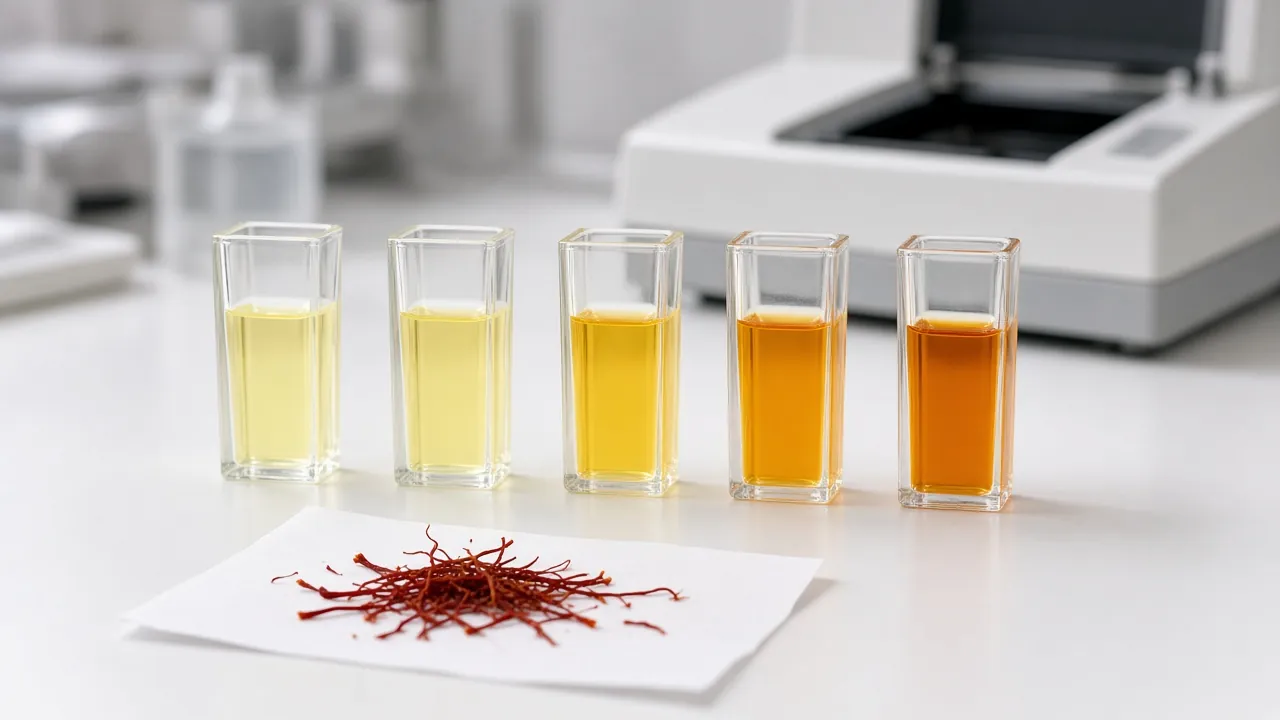
The Three Main Quality Markers
Almost everything you pay for in saffron comes from three compounds made in the red stigma: crocin for colour, picrocrocin for taste and safranal for aroma. All three sit in the red part of the thread, which is why the pale yellow style lowers the value of a gram.
Color strength (crocin levels)
Crocin is the pigment that turns rice and broth gold. Labs do not report it as a percentage. They dissolve a weighed sample and measure how strongly a 1% solution absorbs light at 440 nanometres, corrected to dry weight. That figure is called colouring strength. A higher number means more colour from each thread, so a smaller pinch does the same job.
Aroma strength (safranal)
Safranal forms while the threads dry, when heat and the flower’s own enzymes split picrocrocin. It is read at 330 nanometres. Unlike the other two markers, the 2011 edition of ISO 3632 sets a window for it, 20 to 50, rather than a minimum. A reading above 50 is outside the specification, not a sign of extra quality.
Flavor and bitterness (picrocrocin)
Picrocrocin gives saffron its slightly bitter, hay-like taste and is the parent molecule of safranal. It is read at 257 nanometres. The 2011 edition asks for at least 70 for Category I. Use too many threads in one dish and this is the bitterness you notice.
Why these three matter more than appearance alone
Long, even, deep-red threads tell you the saffron was trimmed and sorted with care. They do not tell you its age, how it was dried, or whether the colour came from the flower. Old saffron can look fine after its aroma has gone, and dyed threads are made to look perfect. The three readings describe what the pinch will actually do in the pot.
ISO 3632 Grading Explained Simply
What ISO 3632 actually tests
ISO 3632 has two parts. Part 1 sets the specification; Part 2 describes the test methods. Under the 2011 edition a sample is checked for:
- moisture and volatile matter;
- extraneous matter from the plant itself (floral waste such as separated styles, stamens, petals and pollen) and foreign matter from anything else;
- total ash and acid-insoluble ash (mineral residue such as grit);
- how much dissolves in cold water;
- the three absorbance readings for colour, bitterness and aroma;
- artificial colourants, which must be absent in every category.
Category I requirements
| Measure | Category I | Category II | Category III |
|---|---|---|---|
| Colouring strength, crocin (440 nm), minimum | 200 | 170 | 120 |
| Bitterness, picrocrocin (257 nm), minimum | 70 | 55 | 40 |
| Aroma, safranal (330 nm) | 20 to 50 | 20 to 50 | 20 to 50 |
| Moisture and volatile matter, maximum | 12% | 12% | 12% |
| Floral and plant waste, maximum | 0.5% | 3% | 5% |
| Foreign matter, maximum | 0.1% | 0.5% | 1% |
| Total ash, maximum | 8% | 8% | 8% |
| Artificial colourants | Absent | Absent | Absent |
A sample has to meet every line in a column to sit in that category. A high colour reading cannot make up for too much floral waste.
How to read a saffron lab report
- Who and whenLook for the laboratory’s name and contact details and the date the sample was tested.
- Which saffronFind a sample or lot number. It should match the lot printed on the tin you are buying.
- Which methodThe report should name ISO 3632 and its edition, and give results “on dry matter”.
- The three numbersRead colouring strength (440 nm), bitterness (257 nm) and aroma (330 nm) against the table above.
- The clean-up linesCheck moisture, floral waste and the artificial colourant result.
- The conclusionA category is only as good as every line beneath it. If the report states “Category I” but a number misses the limit, trust the number.
Do all high-quality saffrons have lab reports?
No. Testing costs money for every lot, and plenty of small farms and spice shops sell good saffron without paying for it. Much of the saffron on retail shelves carries no ISO category at all. A missing report means the strength is unknown, not that it is poor. A report counts for most when it covers the lot you are buying.
What “All-Red” or Super Negin Actually Means
Difference between all-red saffron and Super Negin
“All-red” describes a cut: the yellow-white style has been snipped away so only red stigma remains. In the Iranian trade, all-red threads are called Sargol when the three stigmas have come apart and Negin when they are still joined. Spain calls the all-red cut Coupé; Kashmir calls it Mongra. “Super Negin” is a sellers’ term for the longest, thickest and most even Negin threads. We have found no standard that defines it. All Super Negin is all-red, but most all-red saffron is not Super Negin.
Does Super Negin always mean higher quality?
Not always. The name tells you about trimming and sorting, which is labour you can see. It says nothing about harvest year, drying or storage. Freshly harvested Sargol can out-colour a Super Negin that has spent years on a bright shelf. Read the name as a statement about appearance, then look for the harvest year and the lab numbers.
Visual grade vs chemical strength
The two usually move together but are not the same thing. Sargol and Coupé, the all-red cuts, would typically fall into ISO Category I. Pushal and Spanish Mancha grade, which keep some style, would probably land in Category II. Those are typical outcomes, not guarantees. The grades guide lays the cuts out side by side.
Harvest Year and Freshness
How long saffron stays potent
Dry saffron breaks down quickly when it meets light and oxygen, which is why it belongs in airtight, dark containers. Safranal is volatile, so aroma tends to fade before colour does. ISO 3632-1 does not set a shelf life, and sellers set their own best-by dates; one Herat seller we track prints 24 months from packing. As a kitchen rule, buy an amount you will finish within about a year of opening.
Why recent harvest year matters
The saffron crocus flowers once a year, in autumn, so every crop has a year the way wine does. A harvest year tells you the oldest the threads can be. Without one, the jar could hold last autumn’s crop or stock that has sat in a warehouse for several seasons.
How to check harvest year when buying
- Look for a printed harvest year (or season) on the label or listing, separate from the best-by date.
- Ask the seller which harvest the current stock comes from. A good seller answers in one line.
- Match the lot number on the tin to the lot on any lab report; the test date should fall after the harvest.
- Read “new crop” with no year as no information at all.
Packaging and Storage Impact
Best packaging for preserving saffron
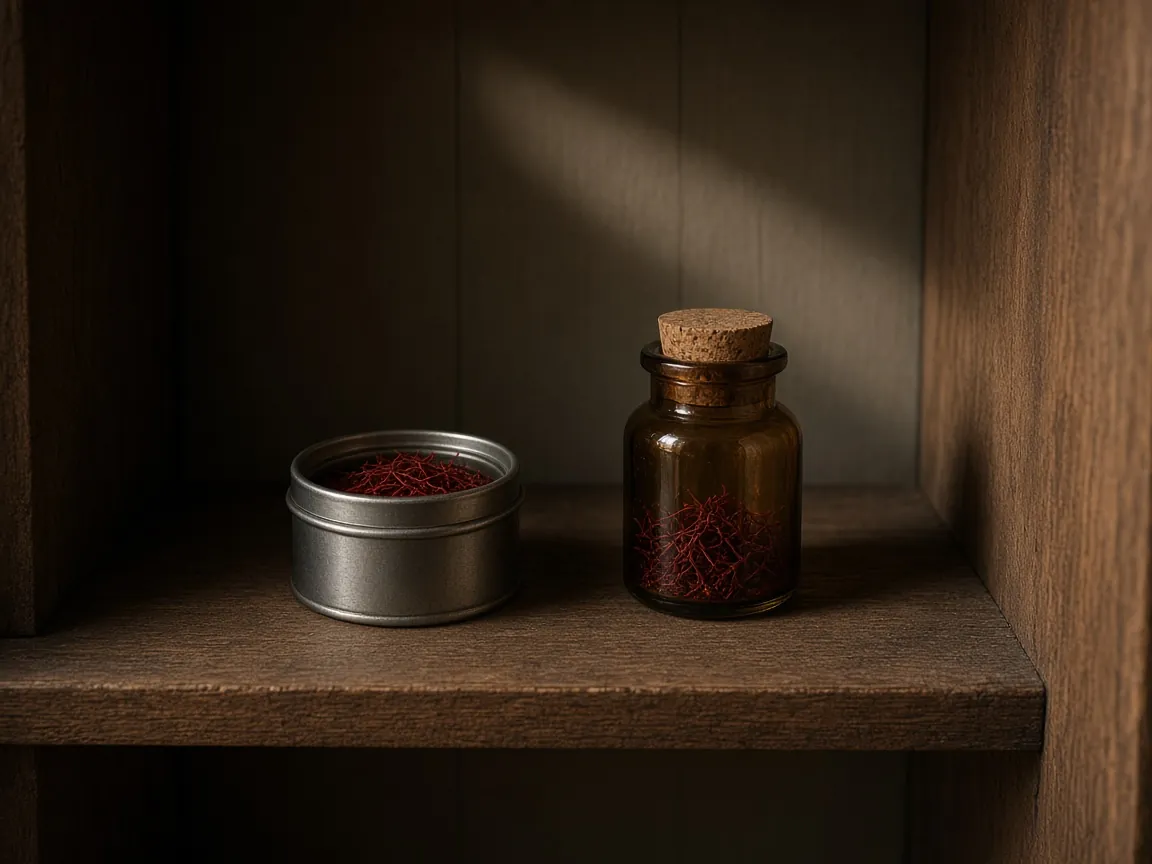
Look for an opaque or tinted container that closes tightly: a metal tin, or dark glass with a snug lid. Small sizes help, because every opening lets in fresh air. Clear plastic sachets hanging under shop lights are the worst case.
How light, air, and heat affect quality
Light and oxygen do the most damage, breaking down the colour and aroma compounds. Saffron copes with heat a little better, but a shelf above the stove adds warmth and steam. Damp is a separate problem: ISO caps moisture at 12% for threads, and threads that pick up kitchen humidity clump and can spoil.
Signs of poorly stored saffron
- Threads that have faded from deep red towards orange-brown.
- A faint, dusty or musty smell instead of a clear honey-and-hay one.
- Brittle threads that crumble, leaving a layer of red dust at the bottom.
- Clumped or soft threads, a sign they have taken on moisture.
Quick Checklist: Signs of High-Quality Saffron
Visual signs
- Deep red threads, thin at one end and flaring into a small trumpet at the other.
- Little or no pale yellow style, unless the label says Pushal or another style-on grade.
- Some natural variation in shade and length; perfectly uniform colour is a warning sign.
Aroma signs
- A strong smell as soon as the tin opens, often described as honey with hay and a faint metallic edge.
- No smell of oil, perfume or nothing at all.
Seller and packaging signs
- Growing country, harvest year, net weight and lot number on the label.
- A lab report for that lot, or a clear answer when you ask for one.
- An airtight, light-proof container and a named company you can contact.
Price red flags
- A “Super Negin” jar priced far below what other whole-thread saffron costs per gram.
- Huge discounts that only make sense if the contents are old, mixed or not saffron.
- Prices quoted per jar with no weight, so you cannot work out the price per gram.
How to work out the price per gram, and the ranges we have actually seen, are in how to spot fake saffron. How origin changes the picture is in best quality saffron by origin.
Related Questions
Is more expensive saffron always better?
No. Price follows cut, jar size, brand and shipping as much as strength. The same lot costs much less per gram in a large tin than in a tiny jar. Compare price per gram, harvest year and lab numbers, not the sticker.
Does organic saffron mean higher quality?
Organic certification is about how the crocus was grown. It is not a measure of colour, bitterness or aroma, and it says nothing about age. Organic saffron can be excellent; it still needs a harvest year and, ideally, a lab report.
Can low-grade saffron still be high quality?
Yes, in the sense that matters most: real, fresh and honestly labelled. Broken all-red threads (Sargol, Coupé) often reach Category I. Pushal, which keeps a little style, gives less colour per gram but can still be clean, recent saffron. See saffron grades explained.
Sources
- ISO 3632-1:2011, Spices — Saffron — Part 1: Specification (second edition, withdrawn 7 July 2025)
- ISO 3632-1:2025 (third edition, July 2025): replaces the 2011 edition and adds an “extra class”
- Scientific Reports (2025), Progress in quality assessment of Italian saffron, Table 1: ISO 3632 category limits
- Kentucky State University Cooperative Extension, Saffron Types and Quality Indicators (fact sheet, 2020–2021)
- Wikipedia, Saffron: grades and ISO 3632 categories, adulteration, world production (read 27 Nov 2026)
Last reviewed 27 Nov 2026. Prices are dated where they appear; lab limits are quoted from the standard edition named beside them.