Guide 3 of 4 · Spot fakes
How to Spot Fake or Low-Quality Saffron
Saffron costs enough to attract fakes, and plenty of real saffron is simply old or poorly made. These are practical checks you can do before you buy and after the jar arrives.
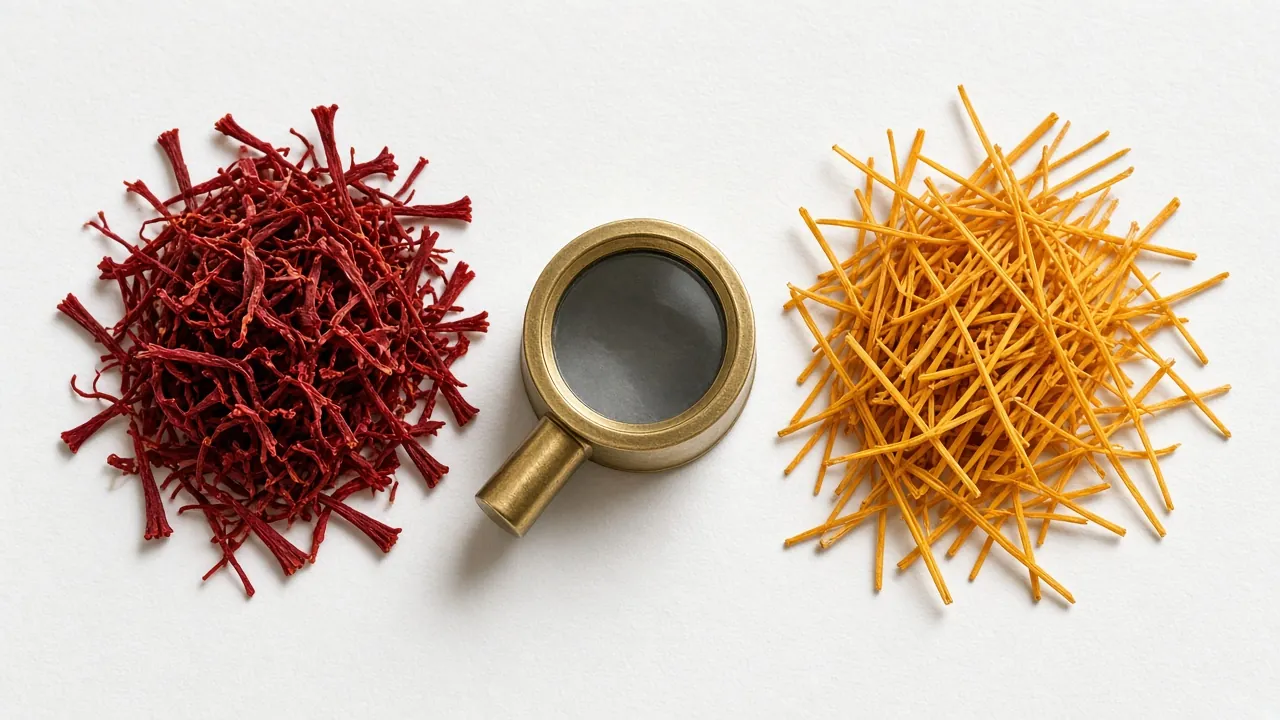
Visual Red Flags
Powdered saffron risks
Ground saffron is the easiest form to fake, because nothing in a powder can be inspected thread by thread. Turmeric, paprika and other powders have been used as fillers, and synthetic yellow dyes such as tartrazine and sunset yellow have been found in counterfeit powder. Unless you know the seller well, buy threads and grind them yourself.
Pale, short, or mixed-color threads
A real saffron thread is red, thin at one end and flares into a small trumpet at the other. Yellow or white pieces mixed in are style, which is legitimate only if the label says Pushal or similar. Straight, even orange-yellow strands with no flared tip are often safflower, the most common stand-in sold as saffron.
Signs of dyed threads
Dyes produce a flat, uniform red with no natural shading from base to tip. Dyed fakes tend to stain wet fingers red, and they cloud water red or orange within seconds. Materials found dyed and sold as saffron include corn silk, silk fibre, shredded paper, beetroot and pomegranate fibres, and the crocus flower’s own tasteless yellow stamens.
Too many broken pieces
Some breakage is normal in Sargol and Coupé. A jar sold as Super Negin that is mostly short pieces and dust is not what it claims to be, and a lot of red powder at the bottom of any jar points to age or rough handling.
Smell and Water Test (and Their Limits)
What real saffron should smell like
Real saffron smells strongly the moment you open the jar, often described as honey with grassy, hay-like notes and a slight metallic edge. Fakes often smell of nothing, of dye, or of the oil or honey sometimes used to add weight; threads coated that way can also feel sticky or look glossy.
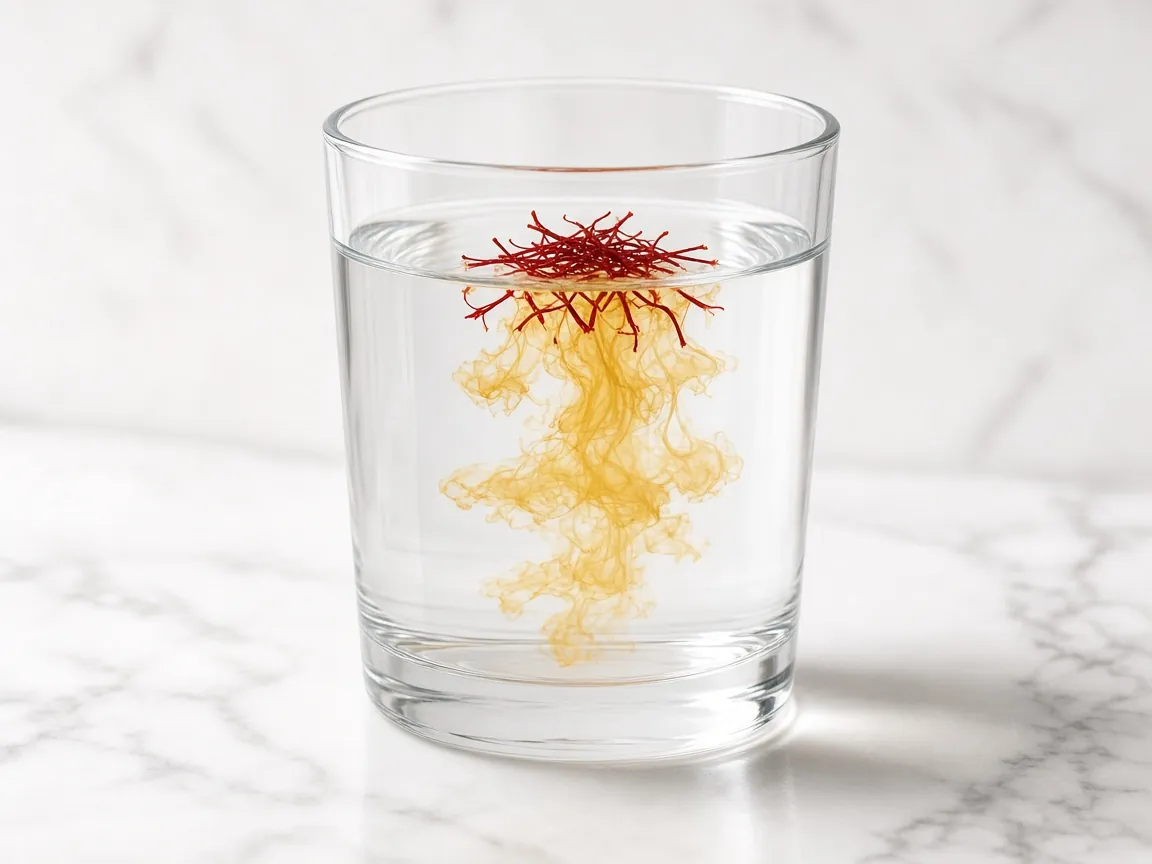
How to do the water test correctly
- Set upFill a clear glass with room-temperature water and put it against a white background.
- Add a few threadsDrop in three or four threads. Do not crush them.
- Watch for five minutesReal saffron releases slow golden-yellow streams. The threads stay red for a good while.
- Check after fifteen minutesThe water should be clear yellow-gold, not red. Dyed threads tend to bleed red or orange at once and then fade towards white.
Why home tests are not fully reliable
Home tests catch crude fakes. They cannot catch a blend that contains enough real saffron to colour the water, and they cannot detect gardenia extract, which contains crocins much like saffron’s and has been found in saffron sold in Europe. Detecting it takes laboratory chromatography. Old, genuine saffron also passes the water test while having lost most of its aroma. Use these tests to rule saffron out, never to prove it is good.
Packaging and Seller Red Flags
Missing origin information
A label should say where the saffron grew. “Packed in” is not the same claim: Spain exports far more saffron than it grows, and some saffron sold as Kashmiri has been mixed with imports. If the only origin on the tin is where it was packed, assume the growing country is unknown.
No harvest year listed
Saffron is a once-a-year crop. A seller who knows the harvest year has little reason to hide it. No year means the threads could be any age.
Vague or missing brand details
Look for a company name, a contact address, a net weight in grams and a lot number. Marketplace listings with stock photos, no company details and a different brand name on every photo are a common pattern for poor or fake saffron.
Suspicious bulk discounts
Modest multi-buy deals are normal: a few tins at 15% or 20% off is the sort of offer we have seen on a dated reading. Deep “wholesale” prices offered to someone buying a few grams are not normal. If a large discount makes the price per gram fall far below anything else you can find, ask why before you pay.
Price That Seems Too Good to Be True
Realistic price ranges for quality saffron
These are real US list prices for whole-thread saffron, all Afghan-grown, from the board on saffronprice.com, read on 20 Nov 2026 (and 25 Nov for one seller). They are one origin and three sellers, so read them as a reference point, not a world price.
| Jar size | Lowest per gram seen | Highest per gram seen | Listings |
|---|---|---|---|
| 0.5 g | $19.98 | $29.98 | 2 |
| 1 g | $12.00 | $15.99 | 2 |
| 2 g to 5 g | $8.40 | $10.00 | 3 |
| 10 g | $5.90 | $5.90 | 1 |
| 1 oz (28.35 g) | $5.26 | $7.05 | 3 |
Two patterns stand out. Small jars cost three to six times more per gram than large tins, and the cheapest gram we saw anywhere was $5.26, in a 1 oz tin.
Affiliate links: we earn a commission if you buy through this or any AfgSaffron link on this page, at no extra cost to you.
Why extremely cheap Super Negin is usually fake
A kilogram of saffron takes roughly 150,000 flowers picked by hand, and Super Negin adds trimming every thread and sorting the results by size. That is the most labour-heavy saffron there is. We cannot say how often a bargain jar is fake, but when a small jar of “Super Negin” costs a fraction of the lowest per-gram price above, the arithmetic rarely works. The likelier explanations are a lower grade, old stock, a blend, or something that is not saffron.
How to compare price per gram
- Divide the price by the net weight in grams. For example, $42 for a 5 g tin is $8.40 a gram.
- Convert ounces at 28.35 g. A $149 one-ounce tin is about $5.26 a gram.
- Add shipping before you compare, especially on small orders.
- Compare similar sizes. A 0.5 g jar will always lose to an ounce tin on price per gram.
- Think in pinches too. About 0.1 g colours a dish for four, so even a $20-a-gram jar costs around $2 a dish.
Lab Reports: What to Look For
What a real ISO 3632 report includes
- The testing laboratory’s name, address and, ideally, its accreditation (labs are accredited to ISO/IEC 17025).
- A sample or lot number, the date the sample was received and the date of testing.
- The standard and edition used, for example ISO 3632-1:2011 with methods from ISO 3632-2.
- A results table with units: moisture, floral waste, foreign matter, ash, the three absorbance readings and an artificial-colourant result.
- A conclusion naming the category, and a signature or authorisation.
Crocin numbers explained
The “crocin” figure on a report is not a percentage of crocin. It is the absorbance of a 1% saffron solution at 440 nm in a 1 cm cell, on dry matter. Category I needs at least 200 under the 2011 edition; Category II needs 170 and Category III 120. The finest selected stigma tips can read above 250. A number with no wavelength or unit is not a usable result.
Batch-specific vs generic reports
A report describes one sample. It applies to your tin only if the lot number matches. A single “certificate” on a website with no lot number, or a report several harvests old, tells you about some saffron the seller once had.
Common fake lab report warning signs
- No laboratory name or contact details, or a lab you cannot find anywhere.
- No date, no lot number, or a lot that is not printed on the tin.
- Readings without wavelengths or units, or round numbers that look typed rather than measured.
- A safranal reading above 50 presented as Category I. Under the 2011 edition, that is outside the specification.
- “ISO certified saffron” with no category and no report. ISO writes standards and does not certify products itself.
- The same report image appearing on several different sellers’ pages.
Practical Buying Checklist
Pre-purchase checks
- Threads, not powder.
- Growing country stated, not just “packed in”.
- Harvest year on the label or in the listing.
- Net weight in grams, so you can work out the price per gram.
- A price per gram in a believable range for the jar size.
- A lot number and, ideally, a lab report for that lot.
- A named seller with a returns policy and a way to contact them.
What to verify after it arrives
- The lot number and harvest year on the tin match the listing.
- The threads are red, flare at one end, and match the grade you paid for.
- The smell is strong and clean as soon as you open it.
- Three threads colour a glass of water slowly yellow-gold, not red.
- No stickiness, gloss or dust, and the seal was intact.
For what the numbers on a report mean, see what makes saffron high quality. For what each grade should look like, see saffron grades explained. For which origins are easiest to verify in the US, see best quality saffron by origin.
Related Questions
Can you tell fake saffron by looking at it?
Often, yes, for crude fakes: safflower, dyed fibres and stamens look wrong up close. A blend of real saffron with fillers or a cheaper grade can look convincing, which is why the water test, a harvest year and a lab report still matter.
Is cheap saffron always fake?
No. Large tins are much cheaper per gram than small jars. On 20–25 Nov 2026 we saw a real 1 oz tin at $5.26 a gram. Pushal is also cheaper than all-red cuts. Cheap is a reason to check, not proof of fraud.
How common is fake saffron?
We could not find a reliable figure we would stand behind. Adulteration has a long record, from medieval Europe to recent cases of gardenia extract in saffron sold in Europe, and it is concentrated in the cheapest products and in powder.
Sources
- Wikipedia, Saffron: grades and ISO 3632 categories, adulteration, world production (read 27 Nov 2026)
- Kentucky State University Cooperative Extension, Saffron Types and Quality Indicators (fact sheet, 2020–2021)
- ISO 3632-1:2011, Spices — Saffron — Part 1: Specification (second edition, withdrawn 7 July 2025)
- Scientific Reports (2025), Progress in quality assessment of Italian saffron, Table 1: ISO 3632 category limits
- Shepro (2020), The Geopolitics of Saffron and the Puzzles of Saffron Arithmetic, Oxford Symposium on Food & Cookery
Last reviewed 27 Nov 2026. Prices are dated where they appear; lab limits are quoted from the standard edition named beside them.