Guide 2 of 4 · Grades
Saffron Grades Explained
Grades describe how saffron was trimmed and sorted. They shape how it looks and often what it costs, but they are only part of the quality picture.
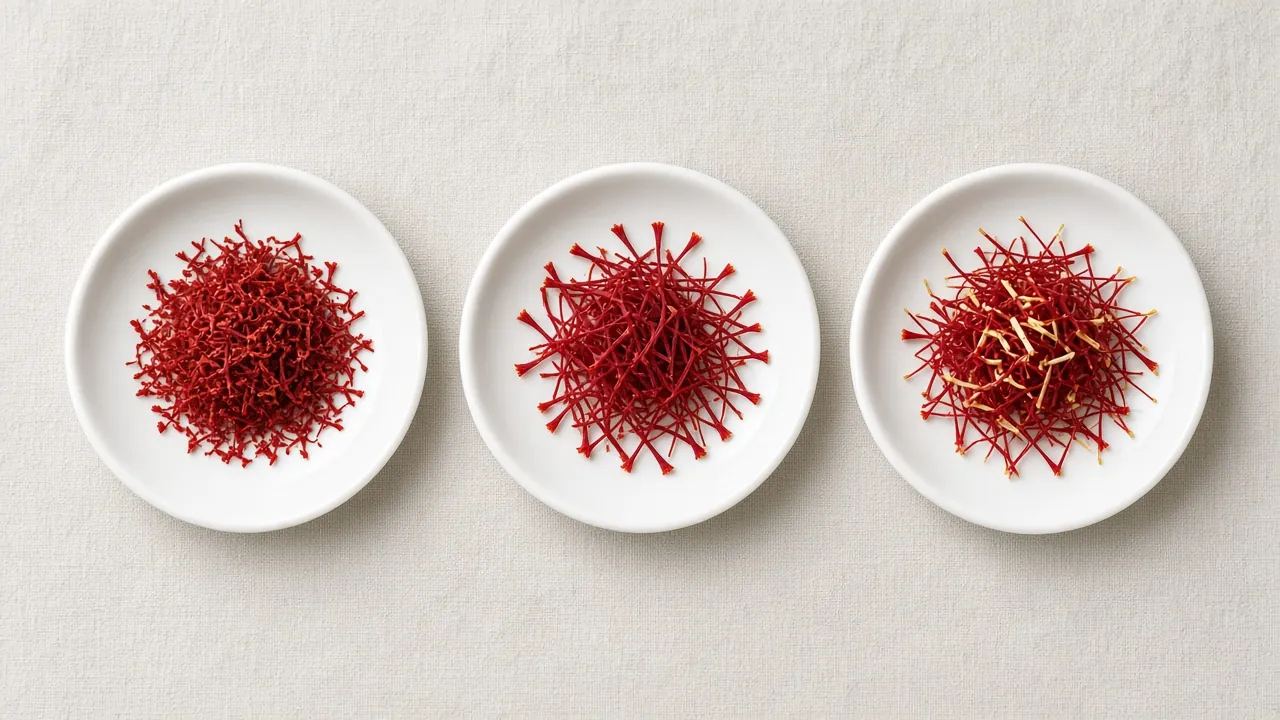
Most grade names on US shelves come from the Iranian trade, with Spanish and Kashmiri equivalents. They all answer one question: how much of the pale yellow style is left on the red stigma, and how neatly were the threads sorted? For what a lab measures, see what makes saffron high quality.
Super Negin
What Super Negin looks like
Long, thick, all-red threads, even in length and colour, with the style cut away. Negin-type threads keep the three stigmas joined, so many threads look like small three-pronged sprays. It is the most handled grade on the market: every thread trimmed, then sorted again for size.
Super Negin vs regular Negin
The difference is sorting, not chemistry. Super Negin is a seller’s top pick of Negin by length, thickness and evenness. No standard we could find defines the cut-off, so one seller’s Super Negin can look like another’s Negin.
Is Super Negin the best grade for cooking?
For colour and flavour, threads from the same lot give much the same result whether they are long or short, as long as both are all-red. Once saffron is steeped in warm water and stirred into rice or a stew, thread length disappears. Super Negin earns its price when the threads stay visible: a garnish, a clear syrup, or a gift.
Typical uses and price range
Gifts, garnishes and dishes where you want whole threads on show, as well as everyday cooking if the price per gram suits you.
Affiliate links: we earn a commission if you buy through this or any AfgSaffron link on this page, at no extra cost to you.
Negin
Characteristics of Negin saffron
All-red threads with the style removed and the three stigmas still joined at their base. Threads are generally longer and more intact than Sargol because they have not been separated.
Negin vs Super Negin differences
Same cut, looser sorting. Negin accepts a wider range of lengths and a few shorter threads. If both come from the same lot, expect similar colour per gram and a lower price for Negin.
When Negin is the better choice
When you want whole-looking threads for cooking without paying for the final sort. It is a sensible middle ground for people who cook with saffron often and like to see the threads.
Sargol and Coupe
What is Sargol saffron?
All-red stigma tips with the style removed, where the three stigmas have come apart into single threads. Threads are shorter and more varied than Negin, and some are broken. Older references call Sargol the strongest Iranian grade, because it is pure stigma.
Spanish Coupe vs Iranian Sargol
Coupé is the top cut in the Spanish trade grades, and it is the Spanish name for the same idea: stigma only. Spain’s trade grades then step down through Mancha, Río, Standard and Sierra as more style is left on. These grade names describe the cut and say nothing about where the saffron grew. That is a separate claim, covered on the origin page.
Why broken threads can still be high quality
Colour, bitterness and aroma live in the red stigma, and a broken stigma is still stigma. Breakage comes from trimming, separating and packing, not from weakness. All-red cuts like Sargol and Coupé would typically meet ISO Category I. Crumbs and dust are a different matter: a lot of powder at the bottom of a jar suggests age or rough handling.
Best uses for Sargol/Coupe
Anything where the saffron is steeped and stirred in: rice, stews, paella, risotto, breads and custards. You get all-red strength without paying for long threads you will never see.
Pushal and Lower Grades
What is Pushal saffron?
Red stigma with a short piece of yellow style still attached, typically 2 to 3 millimetres. Spain’s rough equivalent is the Mancha trade grade; Kashmir’s is Lachha. Below Pushal come “bunch” saffron, whole stigmas with a lot of style tied in a small bundle, and Konge, which is style alone.
When lower grades make sense
Pushal is honest saffron when it is labelled as Pushal. It can suit cooks who use a lot and accept slightly less colour per gram. Konge is another matter: it is sold as having some aroma but has very little, if any, colouring power, so it is not a substitute for threads.
How much weaker are lower grades?
Every millimetre of style adds weight without adding much colour, so the reading per gram drops. Pushal and Mancha would probably land in ISO Category II, whose colour minimum (170) sits 15% below Category I’s (200) in the 2011 edition. Those are minimums, not typical readings. At the extremes, the finest selected stigma tips can read above 250, while the old Category IV, dropped from later editions, sat below 80.
Comparison Table
| Grade | Appearance | Color Strength | Aroma | Best Use | Relative Price |
|---|---|---|---|---|---|
| Super Negin | Longest, thickest all-red threads; stigmas joined; very even | All-red: highest for its lot | Depends on freshness more than cut | Gifts, garnish, visible threads | Highest |
| Negin | Long all-red threads, stigmas joined, less evenly sorted | All-red: same as Super Negin from the same lot | Depends on freshness | Cooking where threads show | High |
| Sargol / Coupé / Mongra | Shorter all-red single threads, some broken | All-red: typically ISO Category I | Depends on freshness | Rice, stews, baking | Moderate to high |
| Pushal / Mancha grade / Lachha | Red with 2–3 mm of yellow style | Lower per gram; probably Category II | Similar, slightly diluted | Everyday cooking on a budget | Moderate |
| Bunch (Dasteh) | Whole stigmas with much style, tied in a bundle | Lower again | Diluted | Traditional presentation | Lower |
| Konge | Yellow style only | Very little, if any | Weak | Not a substitute for threads | Lowest |
Which Grade Is Best for Most People?
Best grade for everyday cooking
Sargol, or Negin if the price gap is small. Both are all-red, so a pinch goes as far as it can, and you are not paying extra for length that dissolves into the dish.
Best grade for gifting
Super Negin or a well-sorted Negin in a tin that prints the harvest year and lot number. Long threads look the part, and the label lets the recipient check what they have been given.
Best value grade
Sargol, bought in the largest size you will finish while it is still fragrant. It is pure stigma without the sorting premium. Pushal can cost less again, but part of what you are weighing is style.
How Grades Relate to ISO Category I
Can lower grades still be Category I?
The category depends on lab readings and on how much floral waste is present, not on the grade name. Short, broken all-red threads regularly qualify. Style-on grades start at a disadvantage because the style dilutes the readings per gram, which is why Pushal and Mancha usually sit in Category II. A Category I report on Pushal is possible, but read it closely.
Why grade and lab results should both be considered
The grade tells you what you will see in the jar, and the lab report tells you what the jar will do. Add the harvest year and you have the three facts that decide quality. How to read the report itself is covered in what makes saffron high quality; how origin fits in is in best quality saffron by origin.
Related Questions
What is the highest saffron grade?
It depends on the scale. Among trade names, sellers put Super Negin at the top (Coupé in Spain, Mongra in Kashmir). Among lab classes, ISO 3632 Category I was the highest until the 2025 edition added an “extra class” above it.
Is all-red saffron the same as Super Negin?
No. All-red is the cut: style removed. Super Negin is a seller’s top sort of one all-red cut (Negin) by length and evenness. Sargol and Coupé are also all-red.
Does grade affect cooking strength?
Yes, through the style. All-red grades give the most colour per gram, and style-on grades like Pushal give less. Between all-red grades, freshness and the lot matter more than thread length.
Sources
- Kentucky State University Cooperative Extension, Saffron Types and Quality Indicators (fact sheet, 2020–2021)
- Wikipedia, Saffron: grades and ISO 3632 categories, adulteration, world production (read 27 Nov 2026)
- ISO 3632-1:2011, Spices — Saffron — Part 1: Specification (second edition, withdrawn 7 July 2025)
- ISO 3632-1:2025 (third edition, July 2025): replaces the 2011 edition and adds an “extra class”
Last reviewed 27 Nov 2026. Prices are dated where they appear; lab limits are quoted from the standard edition named beside them.